|
WORKS IN 10
MINUTES!
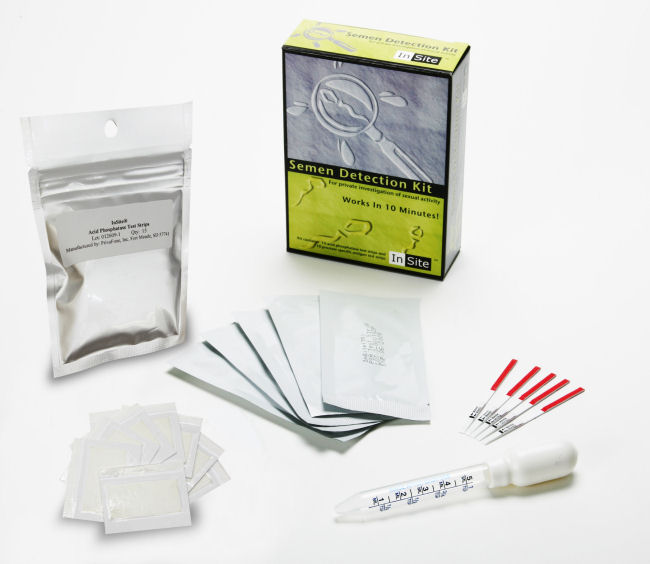
InSite® Semen Detection Kit
For private
investigation of sexual activity
$69.00
FREE
SHIPPING!
Is she
cheating?
Do you suspect
that your spouse is being unfaithful? If so, the
InSite®
Semen Detection Kit can provide evidence of her infidelity.
This kit has prostate specific antigen (PSA) test strips, which work to
provide evidence of semen on a woman's undergarment.
This kit is
designed to be easy to use and yields results after 10 minutes with the
sensitive PSA test.
It will detect traces of semen on a woman's
undergarment which has been discharged after sexual intercourse, and up to 36 hours
later.
Description of the kit
The
InSite
Semen Detection Kit contains 15 PSA
test strips in sealed individual
pouches and a 5-mL dropper.
The PSA strips
can detect semen to a
1/500,000 dilution. The
kit is designed to be used by
men who suspect their spouse may
be engaged in sexual activity
outside of their relationship.
It also can be used by
professional investigators, and
parents concerned about whether
their teenage daughters are
sexually active.
Principle of Action
When a man has sexual
intercourse with a woman, semen
is deposited into the woman's
vagina. Immediately after
intercourse, most of the semen
flows back out, but some is retained in the vagina
and slowly is discharged over a
period of several days
[Ref. 1].
Semen has over 900 identified
proteins
[Ref. 2]
among which are semenogelin I
and II (gel-forming proteins
produced by the seminal
vesicles), prostate-specific
antigen (a protease which breaks
down semenogelin), and acid
phosphatase (which breaks down
spermatozoa cell membranes)
[Ref. 3].
These proteins can be identified
by immunochromatographic assay,
which forms the principle of the
PSA test in the InSite kit. Acid
phosphatase can be detected by
the classic test first described
by Babson [Ref. 4]. This
test relies on the catalytic
hydrolysis of 1-naphthyl
phosphate to form 1-naphthol,
which in turn reacts with an
aryl diazonium salt, forming an
intensely colored azo dyestuff.
In addition to proteins, semen
also has unusually high
concentrations of zinc (100-200
mg/L v. 1 mg/L in plasma)
[Ref.
5].
Zinc acts to stabilize DNA
inside spermatozoa and also may
catalyze the gel-forming
reaction between semenogelin I
and II. Semen may be
detected by the modified zinc
test of Hooft and van de Voorde
[Ref.
6],
but this test does not give as
dramatic a color change at low
dilutions as the AP test. For
convenienc and economy only the
PSA test is included in the
InSite kit.
The semen flowing back out of a
woman's vagina ("backflow") is
deposited on her underwear or
absorbent pad. These items
conveniently can be tested with
the InSite kit.
Sensitivity
Semen may be detected on women's
undergarments which has been
discharged up to 36 hours
after intercourse with the PSA
test strips.
Specificity
The PSA test is 100% specific
for semen at a dilution of
1/500,000 or less. This
means that the probability of a
false positive result is
essentially zero within the
first 12 hours after
intercourse. In order to
be sure that the semen did not
come from you, you must not
have had intercourse with your
spouse for at least three days
prior to the test.
How old can the stain be?
PSA has been detected in semen
stains on garments over 30 years
old [Ref. 7].
Are all stains semen?
NO. Asymptomatic women
produce, on the average, about
1.5 g of vaginal fluid per day,
which typically leaves a white-to-beige
stain [Ref. 8].
Semen stains on the other hand,
are white and appear mainly just
after intercourse. The
next day, discharge of residual
semen may not be visible at all.
Is this a legitimate forensic
test?
The
PSA test can be
used for
the forensic detection of semen
by professional investigators
worldwide. The PSA test in particular has been
validated for use in
forensic investigations, and the
small amount of PSA present in
other bodily fluids has been
shown not to interfere with
the detection of semen.
How does this kit compare
with other test kits on the
market?
The InSite®
semen detection kit has 15 test
strips and is designed for
long-term surveillance, since
sometimes it takes awhile to
catch adulteresses. Most
other kits on the market have
one or two test elements, and
are designed for short-term use.
In addition, the InSite kit is
unique in that it has highly
sensitive and specific PSA test
strips.
In case of a strong stain,
the PSA test is confirmatory for
the presence of semen.
Finally, the PSA test procedure
has been simplified so that the
home user simply extracts the
item to be tested in a coffee
cup, and then inserts a test
strip into the cup with no
laboratory required.
Can this kit be used to test a
man?
The InSite kit will identify
semen stains on garments and
other fabrics, including men's
underwear. However, there
are many legitimate reasons why
a man would have such stains on
his undergarment--for example,
nocturnal emissions.
Therefore, we question whether
any inference of infidelity can
be drawn solely from the
presence of semen stains on the
undergarment of a man.
Such evidence must be combined
with other data, such as direct
surveillance, in order to reach
a meaningful conclusion.
Materials supplied in
the kit
-
15 PSA test strips in
individual sealed pouches
-
5-mL
dropper
-
Instruction sheet
Materials not supplied
but required
-
Distilled or deionized
water
-
Latex gloves
(available from drug store)
-
Coffee cup
Simple procedure
-
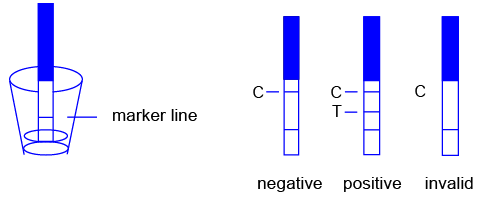
PSA test.
Place 15 mL of water in a coffee cup using the supplied
dropper. Then, manually extract the suspect area (i.e.
crotch) of the garment by repeatedly allowing water to
soak in, then pressing it out. Finally, wring out the
garment into the cup. Place a PSA test
strip into the cup and wait 10 minutes. Then, take
the test strip out and lay it on a clean dry surface.
Read the test strip after 10 minutes. A POSITIVE
test is indicated by two lines as shown below. A
strongly positive test will be clearly visible within
two minutes, while a weakly positive test may take the
entire 20 minutes to become evident.
If you are testing absorptive pads (used during a
woman's menstrual period), then place 25 mL of water
into the coffee cup (for a full pad) or 10 mL for a
mini-pad, and repeatedly extract the pad manually.
Then, wring out the pad into the cup and discard it.
Do the PSA test as usual.
Possible complications
-
Condoms.
If your spouse and her lover are using condoms, there
probably will not be any semen to test. In this
case, you must use other means of surveillance.
-
Vasectomy.
A vasectomy will NOT affect the outcome of the test,
because a man still produces semen. PSA and AP
both come from the prostate gland, which remains intact
after a vasectomy.
-
Menstrual period.
A woman's menstrual period does not interfere with the
detection of PSA by the strips.
-
Variability.
Sometimes the PSA test goes
negative within 24 hours after intercourse, and
sometimes it stays positive for over 36 hours, even in
the same woman only days apart. This variability
may be due to pH changes in the vagina, among
other factors. The vaginal pH is usually around 4,
which is low enough to denature proteins like PSA within
48 hours and render them undetectable. The rate of production and
quality of cervical mucus also varies within the
menstrual cycle. Because of this natural
variability, the item to be tested should have been worn
as close as possible to the time of suspected intercourse.
- False positives.
The PSA test has 100% specificity when the test and
control lines are equal.
Additional information
More information is available
in our White Paper.
View our
instructional video.
Listen to our
radio ad.
Read the
Instruction Sheet in English, Portuguese,
Spanish,
Russian,
French, German
or Arabic.
Read the Specification Sheet
for the PSA strips or
the AP strips.
Still have questions?
Read the FAQ or contact us.
REFERENCES
-
Hooft, P. J.
and van de Voorde, H. P.
American Journal of Forensic Medicine & Pathology
1997, 18, 45-49.
-
Pilch, B.
and Mann, M. Genome Biology 2006, 7:R40.
-
Tanaka, M.
et al FEBS Letters 2004, 571,
197-204.
-
Babson, A.
L. et al, Am. J. Clin. Path. 1959, 32,
pp. 88-91.
-
Owen, D. H.
and Katz, D. F. Journal of Andrology 2005,
26, 459-469.
-
Hooft, P.;
van de Voorde, H. and van Dijck, P. Forensic Science
International 1992, 53, 131-133.
-
SERATEC GmbH.
"PSA in Body
Fluids--an overview for users of the SERATEC PSA
SEMIQUANT Tests."
-
Beckmann, C. R. B. et al.
"Obstetrics and Gynecology, Second Edition";
Williams & Wilkins: Baltimore, 1995; p. 294.
|